Journal · · 3 min read
Arabic calligraphy in stone: inlaying verses, names and crests
From the inscriptions of the Taj Mahal to a family crest at the centre of a table, how letters are cut and set into marble.
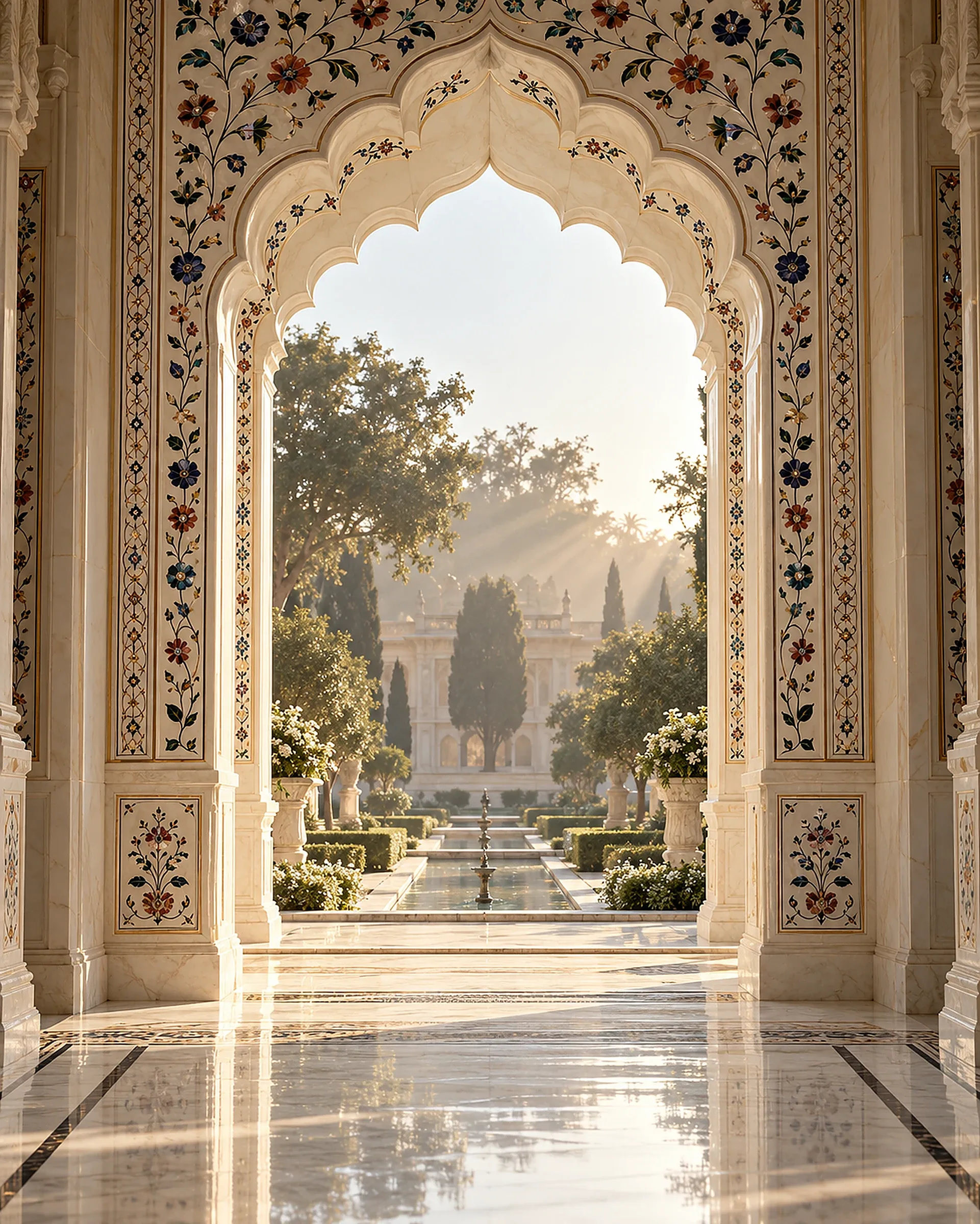
Calligraphy has been set into stone for as long as there have been great buildings in the Islamic world. On the Taj Mahal, verses of the Qur’an frame the great arches in black stone inlaid into white marble, the letters drawn by the calligrapher Amanat Khan and enlarged as they rise so that they appear even from the ground.
How letters are inlaid
Calligraphy in stone follows the same discipline as all pietra dura. The script is drawn at full size, then each letter, and often each part of a letter, is cut from stone and set into the marble ground, so that the finished inscription is part of the stone itself rather than something applied to its surface. Because letters are fine and continuous, the cutting must be exact; a curve that is a millimetre out reads immediately.
The scripts
Thuluth, with its tall verticals and sweeping curves, is the classic architectural script. Naskh is clearer and more compact. Kufic, with its geometry, suits borders and panels. We work from calligraphy drawn by a calligrapher, or from a design you provide, and agree every line before cutting.
Stones for calligraphy
The strongest contrast is black or deep green stone in white marble, as on the Taj Mahal. Lapis lazuli gives a deep blue; gold-leaf rings and borders, and mother-of-pearl, add light. A Bismillah in lapis set within a ring of gold leaf, for example, can become the centre of a foyer.
Where it belongs
Calligraphy can be set into walls and screens, the centre of a table, the border of a floor, a fountain, a mihrab or a majlis. It can carry a verse, a name, a date, or a family crest and monogram drawn for a house.
Care and respect
Sacred texts are drawn and placed with care, and we advise on placement, for example avoiding floors for verses of the Qur’an. Every commission is drawn, approved and then made only once.